Power Magazine | Sonal C. Patel “Passive safety and operational simplicity are fundamental to our Tactical Energy System design,” said Christina Back, GA-EMS vice president for nuclear technologies and materials. “Self-protecting UZrH fuel and pump-free natural-circulation cooling reduce reliance on active systems and operator intervention.”
Five advanced nuclear companies will build, own, and operate more than 20 commercial nuclear microreactors across five U.S. Army installations under the Janus Program, a milestone-based effort designed to place the first project into useful service by September 2028 and establish repeatable commercial products. In exclusive interviews, the selected companies told POWER they intend to use the Army projects as anchor deployments—serving as a crucial bridge from prototype to sustained operation that could establish the operating records needed to unlock broader commercial markets and convert existing customer pipelines into follow-on orders.
In a flagship report published on Aug. 26, U.S. Army Mobilizes $2.2B Janus Program to Deploy More Than 20 Commercial Microreactors, POWER delved deeply into the Army’s rationale for the program. The Army selected BWXT Advanced Technologies for Fort Campbell in Kentucky, Radiant Industries for Fort Benning in Georgia, General Atomics Electromagnetic Systems for Fort Hood in Texas, Antares Nuclear for Fort Bragg in North Carolina, and Westinghouse Government Services for Fort Drum in New York. Combined, the five vendors will draw on up to $2.2 billion in Army investment through fiscal year 2031 under fixed-price, milestone-based Other Transaction Authority agreements negotiated through the Department of War Innovation Unit (DIU).
Selected projects will range in output from 100 kWe to 20 MWe, from single-reactor installations to multi-unit fleets, and target dates ranging from 2028 into the early 2030s and fuel strategies ranging from vertically integrated manufacturing to reliance on emerging suppliers, the advanced nuclear selectees told POWER. At the same time, each company is pursuing similar basic commercial pathways, seeking to leverage Army installations to prove sustained operation, expand manufacturing and fuel capacity, build a regulatory record, and convert an existing pipeline of utility, data center, industrial, and defense prospects into an order book.
A Growing Pentagon Microreactor Portfolio
The selections followed a competition that narrowed a larger group of bidders to 10 finalists. Experts from the Department of Energy (DOE), national laboratories, academia, the private sector, and the military services then subjected each finalist to four hours of questioning, Dr. Jeff Waksman, principal deputy assistant secretary of the Army for Installations, Energy and Environment, said during an Aug. 26 media roundtable. The Army declined to disclose an exact breakdown of the aggregate $2.2 billion, noting that the totals may change over time and that its milestone-based OTA contracts allow funds to be reallocated among vendors as the program progresses.
However, the five Janus selections also expand the Pentagon’s advanced nuclear portfolio. Three of the vendors—Radiant, Antares, and Westinghouse—hold parallel awards under the Air Force’s Advanced Nuclear Power for Installations (ANPI) initiative, announced in April 2026. ANPI narrowed an initial pool of eight prequalified developers to three active deployment tracks, pairing Radiant’s 1-MWe Kaleidos with Buckley Space Force Base in Colorado, Antares’ R1 with Joint Base San Antonio in Texas, and Westinghouse with Malmstrom Air Force Base in Montana. The program seeks to place at least one advanced reactor into operation on a service installation by 2030, although Radiant and Antares have each targeted initial deployment in 2028.
Both Janus and ANPI programs will notably utilize milestone-based Other Transaction Authority agreements negotiated through DIU, draw from an overlapping vendor pool, and target initial reactor operations as early as 2028. However, under ANPI, vendors are pursuing NRC-licensed, contractor-owned and contractor-operated projects, with the Air Force and Space Force expected to buy electricity through long-term power purchase agreements (PPAs). While Janus also assigns reactor ownership, construction, and operation to the selected companies, the Army will regulate the projects under its own nuclear authorities and make fixed-price milestone payments under agreements totaling up to $2.2 billion through fiscal 2031.
Separately, the Air Force’s microreactor pilot at Eielson Air Force Base in Alaska—the original service-installation procurement—launched under a Fiscal Year 2019 National Defense Authorization Act requirement. It paired advanced nuclear reactor developer Oklo with Eielson under a 30-year PPA structure that the Air Force has since carried into ANPI, with commercial operation targeted for 2030 pending NRC licensing. Meanwhile, the Office of the Secretary of Defense’s Strategic Capabilities Office is developing Project Pele, a transportable 1–5 MWe gas-cooled microreactor being built by BWX Technologies at Idaho National Laboratory. BWXT delivered Pele’s full TRISO fuel core in late 2025, and first power is targeted as early as 2028.
General Atomics Advances GA-TES at Fort Hood
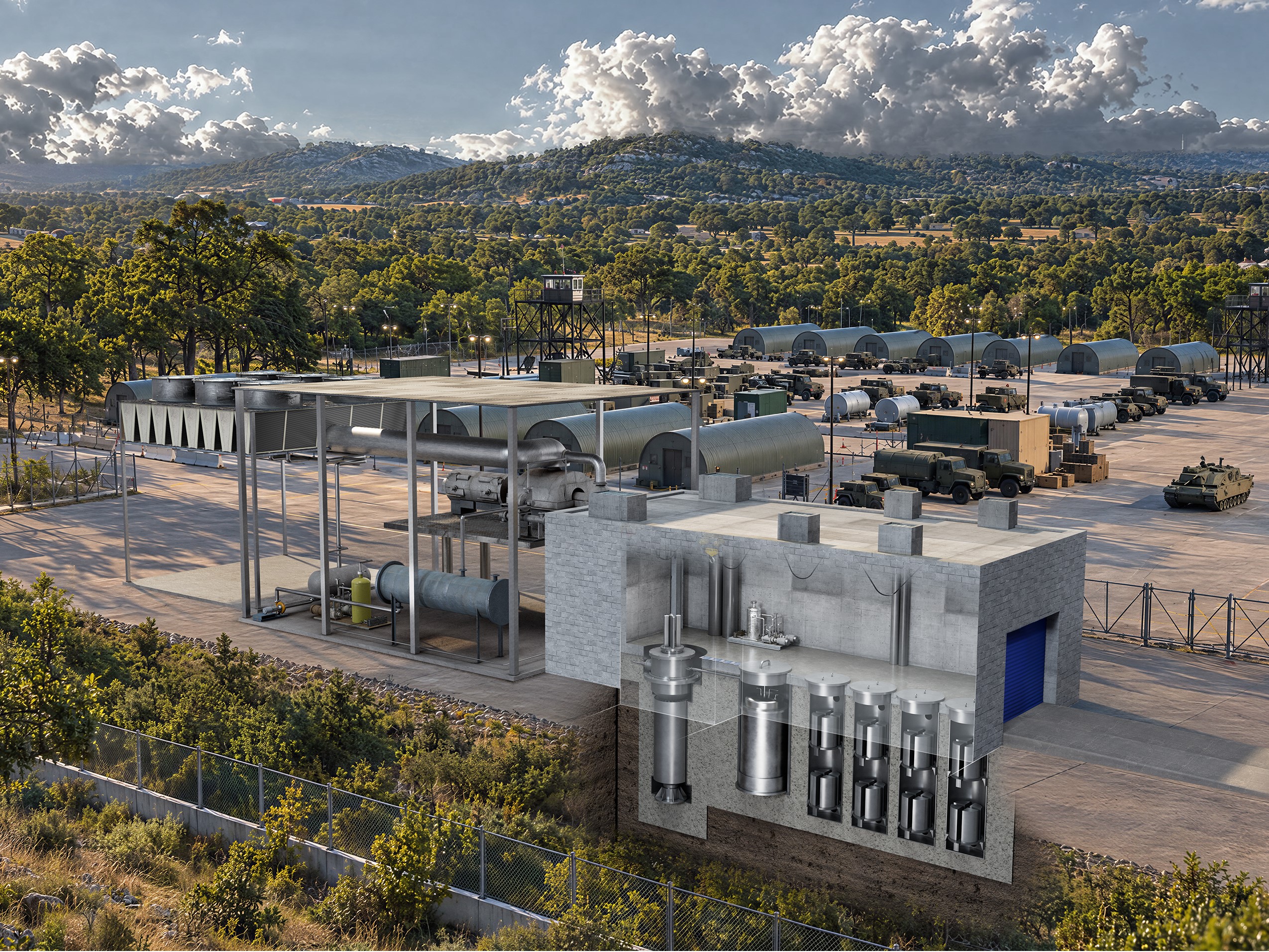
General Atomics Electromagnetic Systems (GA-EMS), the San Diego-based General Atomics business unit, will advance its General Atomics Tactical Energy System (GA-TES) at Fort Hood, Texas, home of III Armored Corps, through development, testing, and site-planning milestones toward potential deployment. The agreement’s value was not disclosed.
GA-TES is the only Janus reactor identified by the five vendors that does not use TRISO particle fuel. The design uses uranium-zirconium hydride (UZrH) fuel and draws on General Atomics’ TRIGA research-reactor heritage, including the fuel’s self-regulating negative temperature coefficient of reactivity. General Atomics says 66 TRIGA facilities have been built across 24 countries during a program spanning more than 70 years. That figure is distinct from the 68 reactors of all types that GA-EMS cited in announcing its Janus selection.
GA-TES is a liquid-metal-cooled reactor that uses natural circulation, requires no large cooling-water infrastructure, and has a baseline net output of approximately 5 MWe. Its architecture is scalable to approximately 20 MWe, and the plant is designed for a 40-year operating life. The modular design supports transport by truck or rail and targets remote, austere, off-grid, and extreme environments, as well as onsite power during broader grid disruptions.
GA-EMS did not disclose a fuel supplier, utility partner, or other project participants for Fort Hood, which is located within the Electric Reliability Council of Texas (ERCOT) footprint.
“General Atomics draws on more than 70 years of nuclear innovation and reactor expertise to deliver microreactor technologies that provide safe, dependable and independent power for military installations,” said Scott Forney, president of GA-EMS. “Our experience designing and deploying 68 reactors worldwide and supporting reactor technologies throughout their lifecycles positions us to deliver assured energy solutions that enhance operational resilience and strengthen mission readiness.”
“Passive safety and operational simplicity are fundamental to our Tactical Energy System design,” said Christina Back, GA-EMS vice president for nuclear technologies and materials. “Self-protecting UZrH fuel and pump-free natural-circulation cooling reduce reliance on active systems and operator intervention.”
For the full policy, regulatory, and contracting picture, see POWER’s flagship report on the Janus Program: U.S. Army Mobilizes $2.2B Janus Program to Deploy More Than 20 Commercial Microreactors.
—Sonal Patel is a POWER senior editor (@sonalcpatel, @POWERmagazine).
Editor’s note: This is a developing story and will be updated as additional project details become available.
Share: